In Saharanpur, at the foot of the Shivalik hills, generations of carvers have turned sheesham and teak into furniture that carries the city’s name around the world.
Saharanpur sits in western Uttar Pradesh, near the Shivalik foothills, and is known across India and beyond as the Wood City. In its old workshop quarters the mallet is never far away, as family-run units carve furniture, screens, boxes, trays and panels in a trade that has defined the city for well over a century. Its beginnings are layered. The geographical indication application describes the craft as some 350 years old and traces it to artisans from Multan, while the local history Saharanpur Sandarbh records that the industry was established in 1857 by Mohd Attar Hussain, a carpenter from Multan. Another account dates the first organised unit to 1882, set up by Atta Hussain, an immigrant from the same city.
A 19th-century drawing of a wood carver at work in northern India, by John Lockwood Kipling, 1870 John Lockwood Kipling, Public domain
The craft is also said to have been shaped by Kashmiri craftsmen who migrated here, carrying a carving sensibility formed under Mughal patronage. Its products were noticed nationally by the Delhi exhibition of 1902–03, whose catalogue, George Watt’s Indian Art at Delhi, recorded the importance of the region’s woodwork. By the early twentieth century the industry was fully established, and the decades that followed turned it from a court and household craft into an export trade.
The Woods of the Trade
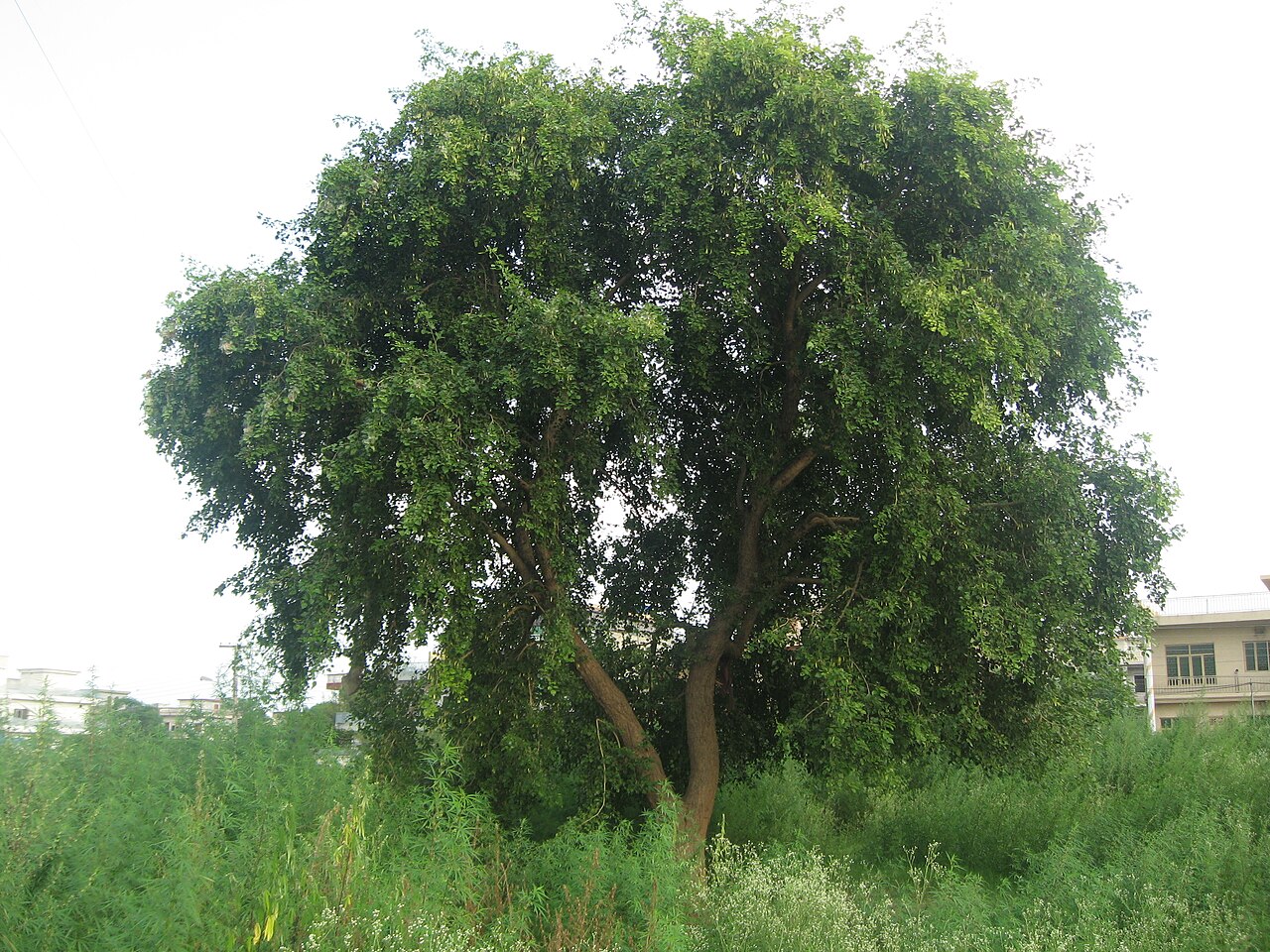
The carver’s first decision is the timber, and in Saharanpur the answer is usually sheesham, or Indian rosewood. Sheesham is dense and dark, with a close grain that takes fine detail, and it resists termites well, which is why it is the default wood for small carved goods such as boxes, trays, bowls and panels. Teak is the furniture wood, strong and resistant to moisture, developing a golden-brown tone with age; dining tables, beds and wardrobes are most often teak. Mango wood suits items given an antique finish, and workshops also use rosewood, deodar, ebony and sal.
Sheesham, or Indian rosewood, the dark close-grained timber most associated with Saharanpur carving Khalid Mahmood, CC BY-SA 3.0
Timber is bought as logs from the mandi, the wood market, and must be seasoned before a chisel touches it, since slow drying keeps the finished piece from warping and cracking. Brass and copper are the other essential materials, used for inlay, and finishes are traditionally natural: shellac, beeswax and oil-based polishes that bring out the grain.
From Log to Carved Panel
Making a piece is a multi-stage relay, and craftsmen usually specialise in one stage and practise it every day. First comes slicing, called lakdi cheerna, in which logs are sawn into flat slabs, often with two men holding the timber steady. The slabs are marked in pencil and cut to shape, and only then does carving begin. A design is drawn on paper and pasted over the surface, or transferred in ink, and the carver works from that guide with chisels, gouges, hammers and mallets, including U-shaped and V-shaped tools. Holes are drilled to open the negative spaces of lattice work.
Carvers at work in the 1870s, in a photograph of sandalwood carvers of the period Unknown author, Public domain
Inlay, the other signature operation, is known as tarkashi: brass strips are cut and die-pressed into floral, geometric or lettered shapes, grooves are carved to receive them, and the metal is beaten in, glued and nailed. Then comes sanding and buffing, the dustiest stage, where putty is rubbed into cracks, left to dry, and sanded smooth again. Polishing follows, often with a lathe mechanism that brings up the shine, and finally the parts are assembled. A carved chair or panel may pass through half a dozen pairs of hands before it is ready for sale.
Motifs and Design Language
Saharanpur’s design language is drawn largely from nature, filtered through Mughal and Persian taste. The signature motif is the vine leaf, a curling, scrolling leaf that runs across panels, chair backs and table aprons, joined by flowers, creepers, trees and fruiting branches. Geometric patterns sit alongside the foliage, jaali lattice turns geometry into something airy, and animal, bird and human figures appear as well. Brass inlay adds a second register: fine dots, floral sprays and lettered designs pressed into dark sheesham. The carved woodwork of an old building in Ahmedabad, shown here, belongs to the same broad Indian tradition of architectural timber carving.
Carved woodwork on a building in Ahmedabad, in the wider Indian tradition of architectural timber carving Bgag, CC BY-SA 3.0
The GI Tag
Saharanpur Wood Craft is a registered geographical indication. Its application, number 184, was filed by the Export Commissioner of Uttar Pradesh and the Wood Craft Design and Development Society of Saharanpur, and the GI certificate was issued on 31 March 2014, according to the state government’s One District One Product portal. The tag protects the name for goods made in the notified area using traditional methods, so a piece made elsewhere and sold as Saharanpur wood craft misuses a protected name. The craft is also the notified product for the district under the One District One Product scheme, launched in January 2018. The tag alone does not guarantee the quality of any single piece, but it anchors the craft to its place of origin.
A 1909 map of Saharanpur district, the notified home of the GI-tagged craft Government of India, Public domain
How to Identify an Authentic Piece
The first test is the carving itself. Hand carving is never perfectly uniform: the depth of a cut varies slightly, a leaf turns a fraction differently from its neighbour, and the underside of a jaali panel shows small drill and chisel marks. Machine-made copies are regular to the point of flatness, with identical motifs repeated exactly and edges that look pressed rather than cut. Real sheesham is heavy for its size, dark and close-grained, and its grain shows through the polish; a piece that feels light, or whose surface looks like plastic, deserves suspicion.
A traditional wooden storage chest with carved panels, showing the dense carved surfaces typical of the craft Aliva Sahoo, CC BY-SA 4.0
Brass inlay should sit flush in its groove, beaten in by hand rather than glued on as a thin foil that lifts at the edge, and the back of a genuine piece is finished with the same care as the front. Be wary of “Saharanpur style” on a label, which usually means the piece was carved elsewhere. A very low price for a large, deeply carved piece is itself a warning: the hours of handwork in a genuine carving cannot sell for the price of a machine-pressed copy.
Where the Craft Stands Today
Saharanpur remains India’s largest wood-carving cluster. A Government of India release of October 2025 put the number of artisans and workers in the sector at about 50,000 to 60,000, serving domestic décor and gifting markets and exporting to Europe, the United States and the Middle East. Furniture, screens, bowls, jewellery boxes and architectural elements are the main exports. The One District One Product programme has given the cluster a Wood Carving Service Centre for training and design support, and artisans such as Mohammad Kafeel, who learned the trade from his teenage years and strengthened his unit with an ODOP-linked facility in 2023, show the craft formalising into small enterprises.
How Wooden Items Are Made in Saharanpur? | Aman All vlogs Watch on YouTube →
The pressures are real. Machine-made furniture undercuts hand-carved work on price, many carvers still work for daily wages, and middlemen and exporters take a large share of the final price. The revival comes from the same forces that threaten the craft: e-commerce has put the workshops before buyers across India and abroad, the GI tag gives the name legal weight, and sellers now market the handwork itself. Whether that keeps young people at the chisel is the open question of the next decade.
How Wooden Carving Tools Are Made & Sharpened | Saharanpur Hand Tool Craftsmanship | MechTech Watch on YouTube →
Turned on a lathe, painted in tin and sealed in lac, Sankheda's maroon-and-gold furniture has carried a Gujarat village's name around the world since the nineteenth century.
Worked from the wrong side of coarse cotton with bright silk floss, Phulkari turned everyday cloth into a garden — and a bride's most personal inheritance.