
Metalwork · South India
Thanjavur Bronze: The Lost-Wax Gods of the Chola Country
In the temple towns of the Thanjavur country, hereditary sthapathis still cast gods in bronze by the lost-wax method the Cholas used a thousand years ago.
Home › South India › Textiles
Woven in a temple town from three-ply mulberry silk and real gold zari, the Kanchipuram sari is South India's bridal cloth — and one of India's first GI-tagged crafts.
Kanchipuram is a town that measures its history in temples. One of Hinduism's seven sacred cities, it holds great shrines such as the Kailasanathar and Ekambareswarar temples, and its streets have held looms for centuries. The silk sari that carries the town's name is worn at weddings and temple festivals across Tamil Nadu, Kerala, Karnataka and Andhra Pradesh, and is the standard against which a South Indian bridal sari is judged. It is a heavy, sculptural cloth: dense silk, a broad contrasting border, and a pallu worked in gold thread, woven so firmly the pieces behave as one fabric.
Local tradition traces the craft to the Chola king Raja Raja I (985–1014), builder of the great Brihadisvara Temple at Thanjavur. According to the weavers' own accounts, the king invited silk weavers from Saurashtra in western India to settle in Kanchipuram and weave cloth for the temples and the court. The weavers, who count themselves descendants of the sage Markanda, the divine weaver of legend, stayed, and their descendants still work the town's looms. The designs borrow their vocabulary from the temples around them: the stepped outlines of gopurams, temple lamps and pillars, and figures carved on shrine walls.

A Kanchipuram sari begins far from Kanchipuram: its silk is pure mulberry silk, reeled in Karnataka around Ramanagara and Sidlaghatta and brought to town as raw yarn. The second defining material is zari, the metallic thread that gives the sari its gold. True zari is made by flattening silver wire and winding it around a silk core, then gilding it with gold, and has traditionally come from Surat in Gujarat. Tamil Nadu's standard for certified zari calls for at least 40 per cent silver and 0.5 per cent gold. Much of what is sold as zari today is cheaper copper-based imitation thread, and the difference is one of the main dividing lines between a genuine Kanchipuram sari and a lookalike.
The silk itself is part of the sari's identity. Kanchipuram weavers work with three-ply silk, known as murukku pattu: three filaments twisted into a single strong thread, giving the cloth its density, slight stiffness and sculptural fold. A wedding sari, zari included, commonly weighs between half a kilogram and well over a kilogram. That weight is why the sari drapes as it does, and why old Kanchipuram saris are handed down rather than worn out.
The making of a Kanchipuram sari is a sequence of separate skilled jobs, many done by different hands in the weaver's house. First the raw silk is degummed, boiled to strip away sericin, the natural gum coating the filament, so the thread softens and takes dye evenly. The yarn is dyed by hand in small lots, dipped in rice water and sun-dried for body, then twisted into three-ply yarn and wound onto bobbins.

The design is drawn first on graph paper, then translated into the loom's lifting order by jala technique or jacquard. Then comes the step that makes a Kanchipuram sari technically unlike any other: korvai. The body, border and pallu are woven as three separate pieces, each in its own colour, and joined on the loom by interlocking their wefts. The work uses three shuttles, and for the finest saris two weavers sit opposite each other, throwing shuttles in coordination. Where the border meets the body, the join leaves a faint zigzag line, and where the pallu meets the body a technique called petni creates a narrow strip of double thickness where warp and weft colours merge. The joins are so strong that if the cloth tears, the border does not separate — that zigzag is the sari's birthmark, and the single most reliable sign of the genuine article. An elaborate sari can take a weaver weeks to finish.

The first thing anyone notices is the contrast: a body in one deep colour, a border and pallu in another, often red against green or magenta against gold. The border, or karai, is usually the widest and most decorated part, and the pallu, or thalaippu, carries the most elaborate zari work. Motifs come from temple architecture and nature: gopuram borders, mango and paisley forms, checks and stripes, the rudraksha bead, the annapakshi or mythical swan-goose, peacocks, elephants and the yali, the composite temple guardian. Some saris carry two borders in different colours, a style called Ganga-Jamuna, and a double-row border known as rettai pettu is favoured for wedding saris, where it is understood as auspicious.
Colour carries meaning too: vermilion, green and yellow dominate the wedding palette. But the design language is not frozen: contemporary weavers work with softer palettes and lighter weights for everyday wear, and new motifs alongside the old, while keeping the korvai structure and contrast border that define the sari.
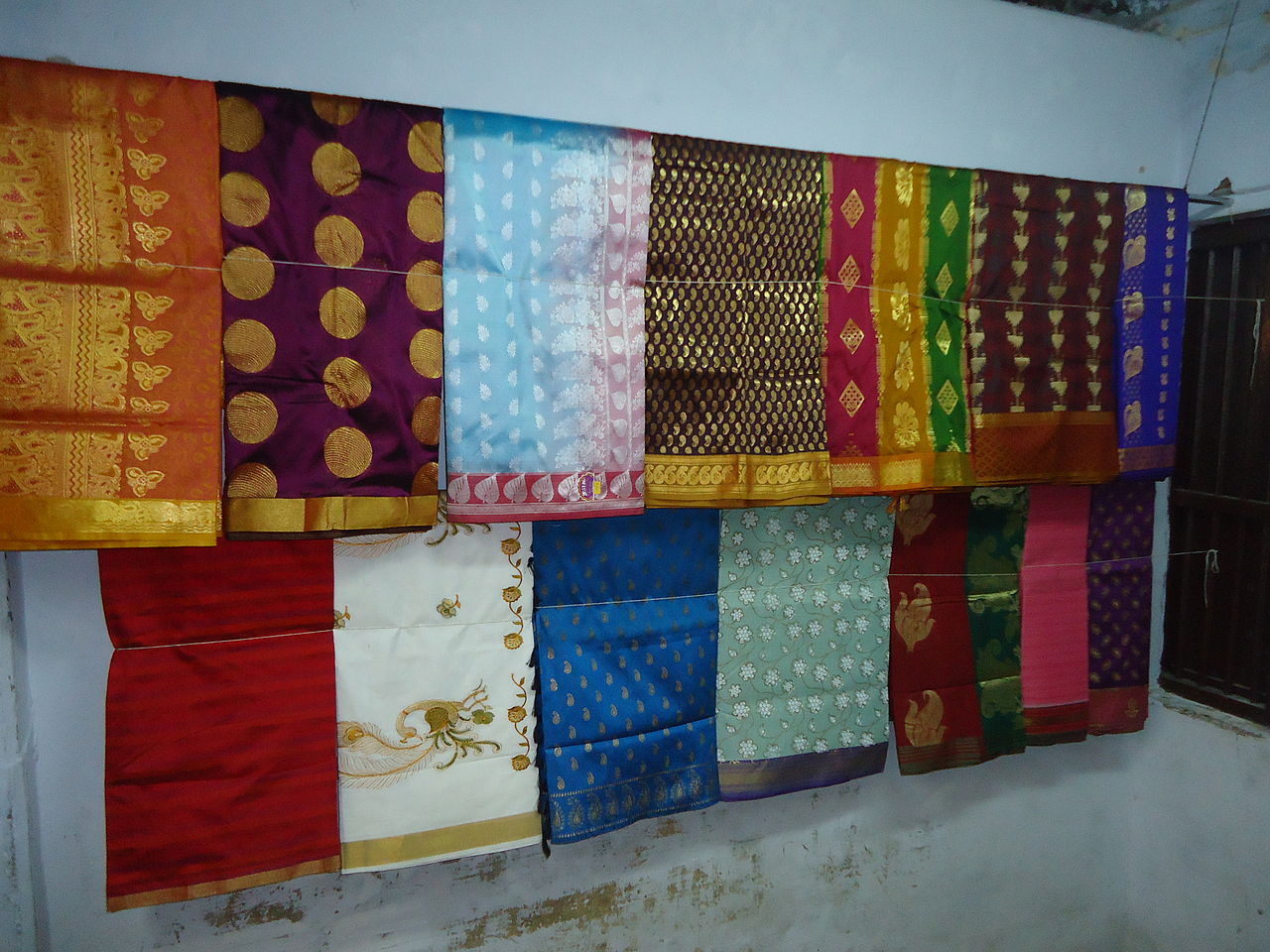
Kanchipuram silk was among the first crafts in India to receive Geographical Indication protection. The Government of Tamil Nadu applied for the tag in 2005, and the Government of India recognised "Kanchipuram Silk Sarees" as a registered Geographical Indication in 2005–06. The tag means only saris woven in the Kanchipuram region, from pure mulberry silk and real zari and by the specified methods, may legally carry the name. In practice the protection is only as strong as buyers' willingness to ask for it: many genuine weavers do not display GI documentation prominently, and the market is full of powerloom saris that borrow the look.

A buyer can make a few checks. First, look at the join where the border meets the body: a genuine korvai join shows the faint zigzag of interlocked wefts, and the border will not peel away when the cloth is pulled. A printed or powerloom imitation has no such join. Second, feel the cloth: three-ply silk is dense and slightly stiff. Third, look at the zari. Real silver-and-gold zari has a soft, deep lustre and does not flake, and its metal content can be tested at the silk testing facilities in Kanchipuram. Fourth, ask for the Silk Mark label and GI certification, and buy from weaver cooperatives or established handloom houses in Kanchipuram itself rather than anonymous online listings. No single check is conclusive, but together they filter well, and a seller who can explain the korvai join is usually worth trusting.

Kanchipuram's silk industry is large — as of 2008 an estimated 5,000 families in the town were involved in sari production — but it is under pressure. Powerloom copies undercut handloom saris on price while borrowing their designs, and younger weavers, faced with long hours at the loom for uncertain returns, leave for other work. The GI tag, the Silk Mark and the weaver cooperatives are the organised response, letting buyers tell the real cloth from the copy and giving weavers a premium to defend. The craft is also finding new ground: lighter saris for daily wear, new colour palettes, and direct sales through exhibitions and the internet have brought the town's looms to buyers who would never have visited Kanchipuram. The sari endures because it is still, unmistakably, itself — a temple town's cloth, woven in three parts and joined without a seam, heavy with silk and gold, worn once at a wedding and kept for a lifetime.
In the temple towns of the Thanjavur country, hereditary sthapathis still cast gods in bronze by the lost-wax method the Cholas used a thousand years ago.

Worked from the wrong side of coarse cotton with bright silk floss, Phulkari turned everyday cloth into a garden — and a bride's most personal inheritance.

In Patan, a handful of Salvi families still tie-dye silk thread by thread, months before a single shuttle is thrown, to weave a sari with no reverse side.